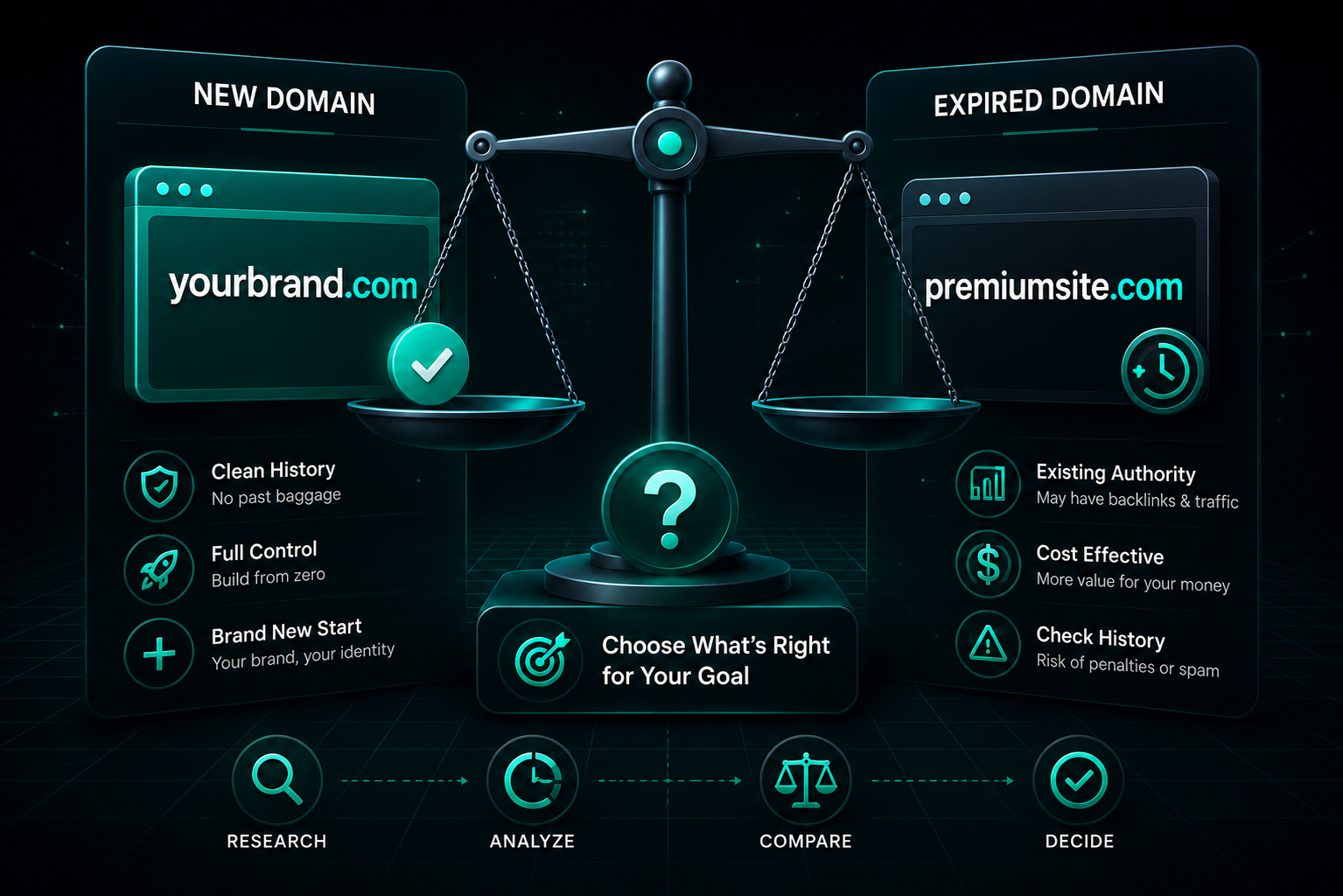
The Choice Every Website Builder Faces
When you're ready to launch a website, one of the first decisions you'll make is where to start your domain's history: from scratch with a freshly registered name, or with an expired domain that carries existing backlinks, authority, and brand history.
Both approaches are legitimate. Both have genuine advantages. And both have real risks that are frequently underplayed by domain brokers and affiliate guides with financial incentives to push you toward the more expensive option.
This guide gives you an honest, comprehensive breakdown of both paths — including when expired domains are genuinely smart, when they're a waste of money, and how to vet them properly if you choose to go that route.
Path 1: New Domain Registration — The Clean Slate
### What You're Starting With
A freshly registered domain is a blank slate. No history, no reputation, no backlinks — and no baggage. From Google's perspective, you're a new entity that hasn't done anything yet, positive or negative.
The typical cost: anywhere from $0.99 to $15 for the first year on a standard TLD (.com, .io, .co), with renewal prices varying by registrar and extension. Hostinger, Namecheap, and Porkbun consistently offer competitive first-year pricing with transparent renewal rates.
### Why New Domains Are Right for Most People
No inherited problems. This is the biggest practical advantage of a new domain. You know exactly what your domain's history is: nothing. You're not inheriting a previous owner's spam campaigns, black-hat link schemes, manual penalties from Google, or toxic backlink profiles.
Full brand control. You're naming your domain to match your brand identity, not working around a name that was meaningful to someone else a decade ago.
Lower financial barrier. A clean new domain at $10/year is accessible to anyone. A premium expired domain with meaningful authority starts at hundreds of dollars and routinely goes into thousands.
Predictable trajectory. With a new domain, you understand exactly what work needs to be done to build authority: publish great content, earn legitimate backlinks, build brand awareness, and wait for the domain to accumulate trust signals. The path is clear even if it takes time.
### The Realistic Downsides
The "Google Sandbox" period. New domains face a documented (if informally named) period of reduced ranking visibility for competitive search terms. This typically lasts 6 to 12 months for most niches. You can publish excellent content from day one and still struggle to rank for competitive keywords while an older domain with similar content ranks easily.
The Sandbox isn't a punishment — it's Google's natural caution around new entities with no established trust history. As your domain accumulates indexed pages, backlinks, brand searches, and positive behavioral signals, the Sandbox effect diminishes and rankings accelerate.
Backlink building starts at zero. Every backlink you need must be earned or built from scratch. For competitive niches where backlink velocity matters, this is a genuine disadvantage versus a domain with an existing link profile.
Brand recognition starts at zero. No existing audience, no brand recall, no search history. You're building from the ground up.
### When a New Domain Is Clearly the Right Choice
- ›You're building a new brand with a specific name and identity
- ›Your budget is limited — you need to allocate resources to content and marketing, not domain acquisition
- ›You want full creative control over your naming and brand
- ›You've found a perfect name at standard registration prices
- ›Your niche isn't hyper-competitive and content quality matters more than domain authority head starts
- ›You're building a long-term business where starting with a strong foundation matters more than a short-term ranking shortcut
Path 2: Expired Domains — Instant Authority (With Real Risks)
### What Expired Domains Are
Every day, thousands of domain registrations lapse. Owners forget to renew. Businesses shut down. Projects get abandoned. When a domain expires, it goes through a lifecycle:
- Grace period (typically 30–45 days): The original owner can renew at standard prices
- Redemption period (typically 30 days): Renewal is possible but at a premium
- Pending delete (typically 5 days): The domain is queued for release
- Drop: The domain becomes available for general registration — often triggering automated bidding wars within seconds
High-value expired domains frequently get caught by domain investors at the drop and listed on auction platforms like GoDaddy Auctions, NameJet, Sedo, or Afternic.
### The Genuine Appeal of Expired Domains
Inherited backlink profile. The primary attraction of an expired domain is its existing backlinks. If the previous site earned legitimate links from reputable sources — media coverage, editorial mentions, industry directories — those links still exist and can transfer authority to your new site.
Faster indexing. Google already knows the domain exists and has historical crawl data for it. New content on an expired domain often gets indexed faster than identical content on a brand-new domain.
Bypassing the Sandbox. A well-vetted expired domain in your niche may significantly reduce or eliminate the Sandbox period, allowing new content to rank faster than it would on a fresh registration.
Existing brand recognition. If the previous site had an established audience or brand presence, some of that recognition may transfer — particularly if you're operating in the same niche.
### The Risks You Need to Understand Completely
This is where many guides go soft because they're monetized by domain brokers. The risks of expired domains are real, substantial, and can permanently damage a new site.
Risk 1: Spam history and Google penalties.
The previous owner may have used the domain for manipulative link schemes, doorway pages, private blog networks (PBNs), pharmaceutical spam, gambling spam, or any number of practices that earned manual or algorithmic Google penalties.
Here's the critical point: Google's penalties can transfer to you when you reregister an expired domain. A domain with a spam history may carry a "negative equity" that actively suppresses your rankings from day one — the opposite of the authority boost you paid for.
Google's John Mueller has confirmed that manual penalties do not automatically reset when a domain expires. And algorithmic penalties (from Penguin, Panda updates, etc.) are embedded in how the algorithm evaluates that domain's link profile — they don't disappear when ownership changes.
Risk 2: Irrelevant or toxic backlinks.
A domain's backlink profile needs to be topically relevant to your new site for those links to provide value. A domain that accumulated links because it was a popular knitting blog won't transfer authority to your new SaaS product — the topical relevance signal is completely mismatched.
Worse, if the previous site's links came from low-quality directories, link farms, or PBN sites, those links may actively harm your new site. Google's Penguin algorithm penalizes manipulative link profiles — and inheriting a manipulated profile means inheriting the penalty risk.
Risk 3: Trademark conflicts.
The previous brand may have a trademark registration that you'd be infringing on by using the same domain. Even if you're registering the domain at standard prices (not squatting), if the trademark holder is still operating and wants the domain back, you may face legal action.
Risk 4: Audience confusion.
Visitors who previously knew the old site may land on your new site expecting the previous content. If expectations are mismatched, this creates poor behavioral signals — high bounce rate, short session duration — that can suppress your rankings.
Risk 5: Hidden acquisition costs.
Quality expired domains with genuine authority don't sell cheap. Expect to pay $500–$5,000 for a domain with meaningful backlinks in a non-competitive niche. In competitive niches (finance, health, legal, real estate), five-figure prices for quality expired domains are common. Add vetting time, potential disavow work, and possibly a domain broker's commission.
### The Right Way to Vet an Expired Domain
If you're determined to pursue an expired domain, this is the non-negotiable vetting checklist:
Step 1: Check the Wayback Machine.
Visit web.archive.org and review the domain's history. What was the site? Was it a legitimate business in your niche? Was it used for spam, adult content, pharmaceuticals, or gambling? Multiple niche changes over its history are a red flag.
Step 2: Analyze the backlink profile.
Use Ahrefs, Semrush, or Moz to audit the full backlink profile. Look at:
- ›Total number of referring domains (not just total backlinks)
- ›Quality of referring domains (domain authority, relevance, traffic)
- ›Anchor text distribution (natural brand/URL anchors vs. heavy commercial keyword anchors indicate manipulation)
- ›Link acquisition patterns (sudden spikes are red flags)
- ›Percentage of links from known link farms or PBN networks
Step 3: Check Google's index status.
Search "site:domainname.com" in Google. If a domain has had content but almost no pages are indexed, it's a strong signal that Google has demoted or penalized it.
Step 4: Check for manual penalties.
If you can access the domain's Google Search Console, check the Manual Actions section. If you can't access it (usual for expired domains), the Wayback Machine history combined with the backlink audit is your best proxy.
Step 5: Use specialized expired domain tools.
Platforms like Spamzilla, DomCop, and ExpiredDomains.net pre-filter expired domains by quality metrics, Moz spam scores, and spam flag indicators. These can significantly reduce the vetting time by filtering out obviously low-quality domains.
Step 6: Check trademark databases.
Search USPTO (United States), EUIPO (Europe), and IPO (UK) for trademark registrations that match the domain name in your industry. A brief trademark search can save you from an expensive legal dispute later.
Step 7: Run a spam score check.
Moz's Link Explorer and Majestic's Trust Flow/Citation Flow scores give you a quick quality signal. A high Moz Spam Score (above 10–15%) is a warning sign that warrants deeper investigation before buying.
### Expired Domain Use Cases: When It Actually Makes Sense
Despite the risks, there are legitimate scenarios where expired domains are a smart strategic choice:
Redirecting to boost a new site. You find an expired domain in your exact niche with 50+ legitimate referring domains from relevant, authoritative sites. You buy it, 301-redirect it to your new domain, and inherit those backlink signals. This is a well-known tactic among experienced SEOs and, done with properly vetted domains, can provide a genuine authority boost.
Rebuilding an abandoned brand. An existing business let a domain lapse but had a real, legitimate audience and brand recognition. If the niche, name, and audience are a good fit for your new project, rebuilding on that brand foundation can be valuable.
Niche authority in low-competition markets. For sites targeting informational niches where content quality drives rankings more than link authority, a well-vetted expired domain can eliminate the Sandbox period and let good content rank faster.
### The Bottom Line: Which Path Is Right for You?
Start with a new domain if:
- ›You're building a new brand with a specific identity
- ›You have limited budget for domain acquisition
- ›You don't have time or expertise to vet expired domains properly
- ›You're in a niche where content quality matters more than domain authority
- ›You want a clean, predictable starting point
Consider an expired domain if:
- ›You have the budget ($500+) and the expertise (or access to an SEO consultant) to vet properly
- ›The domain is in your exact niche with legitimate, relevant backlinks from authoritative sources
- ›The Wayback Machine shows a clean, legitimate site history
- ›No trademark conflicts exist
- ›The authority boost is worth the acquisition premium for your specific competitive situation
Our domain availability checker finds new registrations across 16 extensions instantly — a clean, fast, zero-risk starting point. If you're pursuing expired domains, supplement that with the vetting tools mentioned above before committing a dollar.