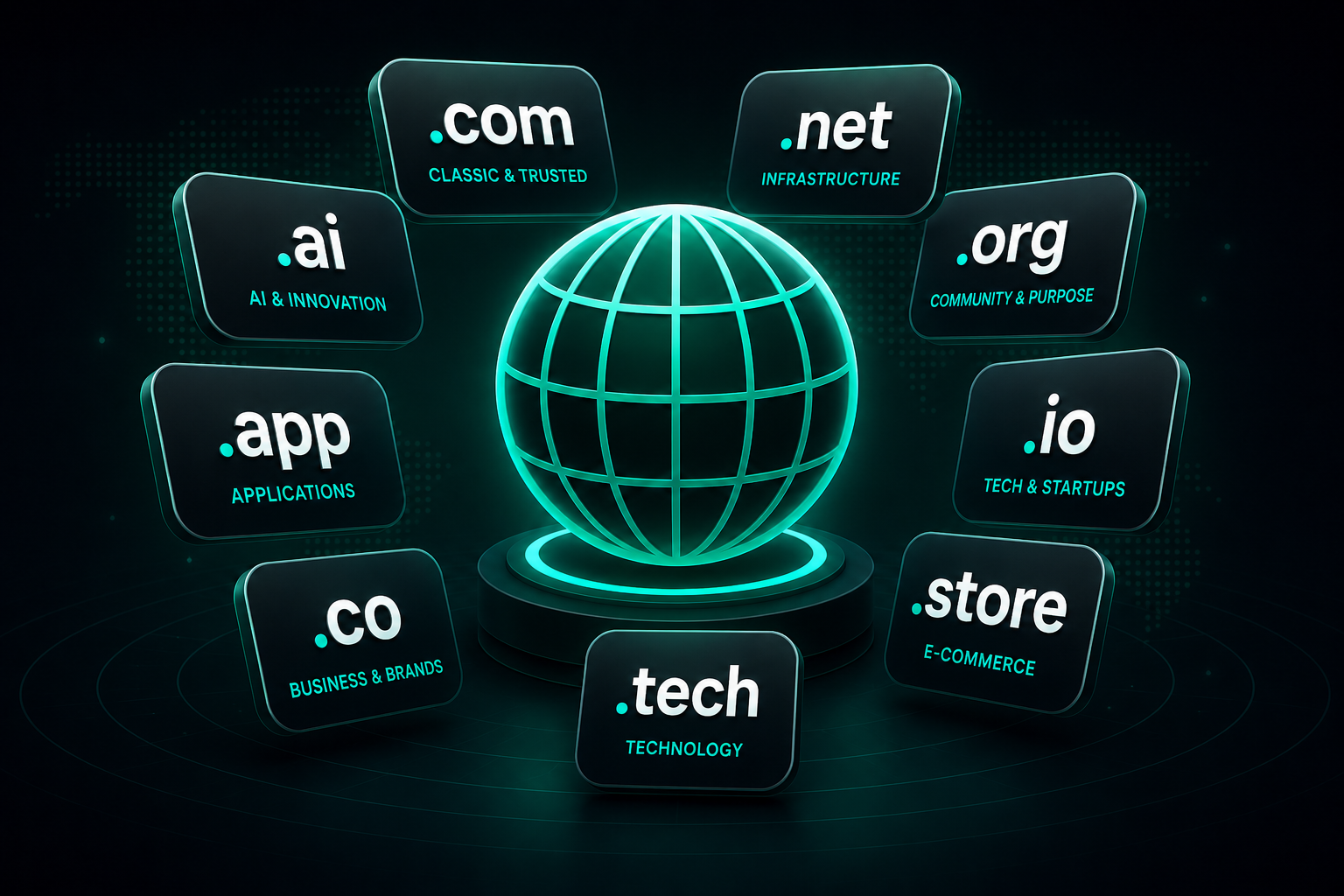
What Is a TLD (Top-Level Domain) and Why Does It Matter?
The part of a domain name that comes after the final dot — .com, .org, .io, .ai — is called a Top-Level Domain, or TLD. It was originally intended as a classification system: .com for commercial entities, .org for organizations, .gov for government, .edu for education. That original taxonomy has blurred significantly, but TLDs still carry meaning, connotation, and trust signals that affect how visitors perceive your brand before they even arrive at your site.
Today there are over 1,500 TLDs available, ranging from original generics like .com and .net to country codes (.uk, .de, .au) to modern generic TLDs (gTLDs) like .app, .store, .tech, and .design. Choosing the right one is both a branding decision and a strategic one.
This guide covers every major TLD in plain English — what it means, who it's for, its SEO implications, and its typical pricing in 2026.
.com — The Undisputed Universal Standard
Origin: 1985. Short for "commercial."
Reputation: Maximum trust, global recognition, default assumption.
.com is the TLD everyone defaults to. When someone hears a brand name, they mentally append .com before any other extension. This "muscle memory" effect is enormously powerful — and enormously expensive to work against if you don't own the .com version of your brand name.
The statistics back this up: .com represents over 37% of all registered domains globally, and consumer surveys consistently show that .com domains receive higher perceived credibility scores than any other extension.
The downside: Premium .com names are mostly taken. The best single-word and two-word .com domains are either owned by active businesses, held by domain investors at five-to-seven-figure prices, or registered as squatted parked pages. Finding a short, memorable, available .com in 2026 typically requires either creative naming, adding words (getname.com, usename.com), or considering alternative extensions.
SEO impact: Google has stated clearly that TLD choice does not directly affect search rankings. However, .com domains consistently perform well because they attract more brand searches, more natural backlinks (people link to .com by default), and higher click-through rates in search results.
Best for: Consumer-facing businesses, e-commerce, personal brands, enterprises, any business where trust is the primary concern.
Typical price: $10–$15/year for new registrations. Premium .com domains can cost hundreds of thousands on the secondary market.
.net — The Reliable Alternative
Origin: 1985. Short for "network."
Reputation: Legitimate fallback, slightly dated, strong trust.
Originally intended for network infrastructure companies, .net has evolved into a widely accepted alternative for businesses that couldn't get the .com version of their preferred name. It carries genuine credibility — more so than most new gTLDs — but is universally perceived as a second choice compared to .com.
The practical risk with .net: if your .com equivalent is owned by someone else, visitors who type your brand name with .com instinctively will land somewhere else. If that site is a competitor or a confusing parked page, you lose traffic and create brand confusion.
Best for: IT companies, internet service providers, network-related businesses, or as a defensive registration alongside your primary TLD.
Typical price: $12–$15/year.
.org — The Non-Profit Signal
Origin: 1985. Short for "organization."
Reputation: Non-profit, community, open-source, trustworthy institutions.
The .org extension carries a specific connotation that has proved remarkably durable: it signals that a site serves the public interest rather than pursuing commercial profit. Wikipedia.org, Mozilla.org, Archive.org — these are the mental anchors users associate with .org.
Using .org for a commercial business is not against the rules (ICANN doesn't restrict .org to non-profits), but it creates a subtle trust mismatch. Visitors may subconsciously expect non-commercial content and feel misled when they find a sales page. Conversely, legitimate non-profits, foundations, and open-source projects gain real credibility from the .org association.
Best for: Non-profit organizations, foundations, charities, community projects, open-source software, advocacy groups, educational institutions without .edu eligibility.
Typical price: $10–$12/year.
.io — The Startup Standard
Origin: 1997. Country code for the British Indian Ocean Territory.
Reputation: Modern, tech-forward, developer-trusted, startup signal.
The .io extension's rise from obscure country code to startup standard is one of the more fascinating stories in domain history. Around 2011–2013, a wave of developer tools and SaaS products — GitHub, Codepen, Heroku — adopted .io, and the extension acquired a cultural meaning far beyond its geographic origin. It reads as "input/output" in computer science, which aligns perfectly with tech products.
Today, .io is widely considered the strongest alternative to .com for B2B SaaS products, developer tools, APIs, and tech startups. It signals modernity and technical credibility to exactly the audience — developers, technical founders, early adopters — who are most skeptical of .com squatting and most willing to accept alternative extensions.
SEO note: .io is treated as a generic TLD (not a country TLD) by Google for global search purposes, meaning it won't geo-restrict your rankings to the Indian Ocean Territory.
Best for: SaaS products, developer tools, APIs, tech startups, B2B software, any product targeting a technical audience.
Typical price: $30–$50/year (premium pricing reflects demand).
.co — Short, Clean, Global
Origin: 1991. Country code for Colombia.
Reputation: Modern alternative to .com, startup-friendly, internationally recognized.
Colombia opened .co registrations globally in 2010, and the extension was quickly adopted by startups and modern brands who wanted the brevity and cleanliness of .com without the scarcity problem. The ".co" reads naturally as "company" or mirrors the "co-" prefix common in collaborative brand names.
High-profile adopters include Angel.co (AngelList), bet.co, and dozens of venture-backed startups. The extension has genuine mainstream recognition now — most non-technical users no longer see it as unusual.
The risk: Like .net, you're betting that users won't accidentally add ".m" and go to .com. For brands where the .com equivalent is owned by a direct competitor, this risk is real.
Best for: Startups, modern DTC brands, companies that want a short, professional domain and couldn't get .com.
Typical price: $25–$30/year.
.ai — The Extension of the AI Era
Origin: 1995. Country code for Anguilla.
Reputation: Premium AI and machine learning signal, high demand, growing mainstream recognition.
If you're building anything with artificial intelligence, machine learning, or automation, .ai has become nearly mandatory for brand credibility in 2026. The extension signals your product's core focus before anyone reads a word of your homepage. Dozens of the most prominent AI companies — from research labs to consumer applications — use .ai domains.
The demand surge has made .ai registrations expensive and competitive. Good one-word or two-word .ai names are largely claimed. Expect to pay registration premiums and face more competition for short names.
AI SEO dimension: As AI search engines become mainstream (Google AI Overviews, Perplexity, ChatGPT Search), websites with .ai domains that publish authoritative content about AI topics gain a subtle credibility signal — the domain extension aligns with the subject matter expertise.
Best for: AI startups, machine learning platforms, chatbot products, automation tools, AI research labs, any product where "AI" is a core feature or identity.
Typical price: $70–$120/year (premium due to demand). Some registrars charge significantly more for short names.
.app — Google's Mobile-First TLD
Origin: 2018. Controlled by Google Registry.
Reputation: Clean, professional, mobile-forward, security-conscious.
Google acquired the .app TLD and launched it in 2018 with one important security requirement: all .app domains must use HTTPS (they're HSTS preloaded at the registry level). This means visitors are always encrypted by default, which is a genuine security advantage over TLDs that don't enforce it.
The .app extension signals clearly that you're building a software product, particularly a consumer-facing application. It's clean, modern, and increasingly mainstream among apps that don't fit neatly into the tech-startup .io category.
Best for: Mobile apps, web apps, consumer software products, app-centric businesses.
Typical price: $15–$20/year.
.dev — For the Developer Community
Origin: 2019. Controlled by Google Registry.
Reputation: Developer-focused, technical, credible in engineering communities.
Like .app, .dev is HSTS preloaded — HTTPS required at the registry level. Unlike .app, it signals a specifically developer-oriented audience: documentation sites, open-source projects, developer tools, coding resources, and technical APIs.
The .dev extension has been enthusiastically adopted by developer documentation sites, open-source project landing pages, and developer tools. It signals "this is for engineers" as clearly as any extension can.
Best for: Developer tools, open-source projects, coding resources, technical APIs, developer-focused products.
Typical price: $12–$18/year.
.store and .shop — The E-Commerce Extensions
Origin: .store launched 2016, .shop launched 2016.
Reputation: E-commerce signal, DTC brands, retail businesses.
Both .store and .shop communicate instantly that you're selling products. They're more available than .com equivalents, often cheaper, and signal retail intent to visitors before they arrive. DTC (direct-to-consumer) brands and Shopify merchants have adopted them extensively.
The trade-off: less universal trust than .com, and some visitors may question the legitimacy of an unfamiliar brand on these extensions. Strong branding and professional design can overcome this, but the initial trust gap is real.
Best for: E-commerce businesses, retail brands, online shops, DTC product companies, Shopify stores.
Typical price: .store at $2–$5/year for first year (heavily promotional), then $30–$40/year. .shop similar.
.tech — For Technology Brands
Origin: 2015.
Reputation: Technology sector signal, professional, widely recognized.
.tech is one of the more successful newer gTLDs, having achieved genuine recognition in the technology sector. It's a clean, professional choice for tech startups, digital agencies, software companies, and technology service providers. More available than .com, with competitive pricing.
Best for: Tech startups, digital agencies, software companies, IT service providers, technology brands.
Typical price: $40–$50/year (first-year promos often available at $5–$10).
How AI Search Engines Are Changing TLD Strategy
In 2026, the rise of AI-powered search — Google AI Overviews, Perplexity AI, ChatGPT Search — has added a new dimension to TLD choice that most domain guides haven't addressed.
AI search engines synthesize information and cite sources. When they cite your brand, the domain name appears as a trust signal to the end user. Extensions that already carry strong associations (.com for credibility, .io for tech tools, .ai for AI products, .org for non-profits) reinforce the brand signal in these AI-generated citations.
More practically: AI search engines are trained on large corpora of web data. Sites on .com, .io, and .org extensions appear more frequently in training data, which may subtly influence how readily those domains are cited versus lesser-known extensions.
For AI SEO purposes:
- ›Choose an extension that aligns with your brand category
- ›Avoid extensions with spam associations (.xyz, .info, .biz have poor reputations)
- ›Prioritize extensions that signal legitimacy (.com, .io, .co, .ai, .app, .dev, .org)
- ›Own your brand's .com if at all possible, even if you primarily use another extension
Checking Availability Across All 16 Extensions at Once
The old workflow — checking each extension one at a time on a registrar's site — is painfully inefficient. Our domain checker shows availability across all 16 major extensions in a single search, with live RDAP data (not cached results).
Type your brand name once, see everything available instantly. No registrar account required. No upsells until you've made your decision. Then register directly through Hostinger with free WHOIS privacy and SSL included.
The right TLD depends entirely on your business type, audience, and the specific name you're working with. Run the search, see what's open, and let the results guide your strategy.